A man with a five year old in a push chair interrupted me.
It was a few weeks ago, in a coffee shop, I was finishing a volume of Ursula Le Guin short stories.
“How old do you think my kids need to be before I get them to start reading Le Guin?”
We agreed she could be quite dark. Yet, the man really wanted to avoid his children getting addicted to Harry Potter. Instead, A Wizard of Earthsea seemed like a good starting point.
This all gives me some kind of hope. I’ve found myself recently feeling that Le Guin is the only person who actually understands the world - something in previous decades I’ve felt about Kurt Vonnegut. So it goes.
(I’ll see your ice-nine, and raise you … instrumental convergence.)
I can’t directly explain why she feels so emotionally valuable in 2026. It’s subtle, she’s subtle. So here is an indirect explanation, via a short review of three books by Ursula Le Guin.
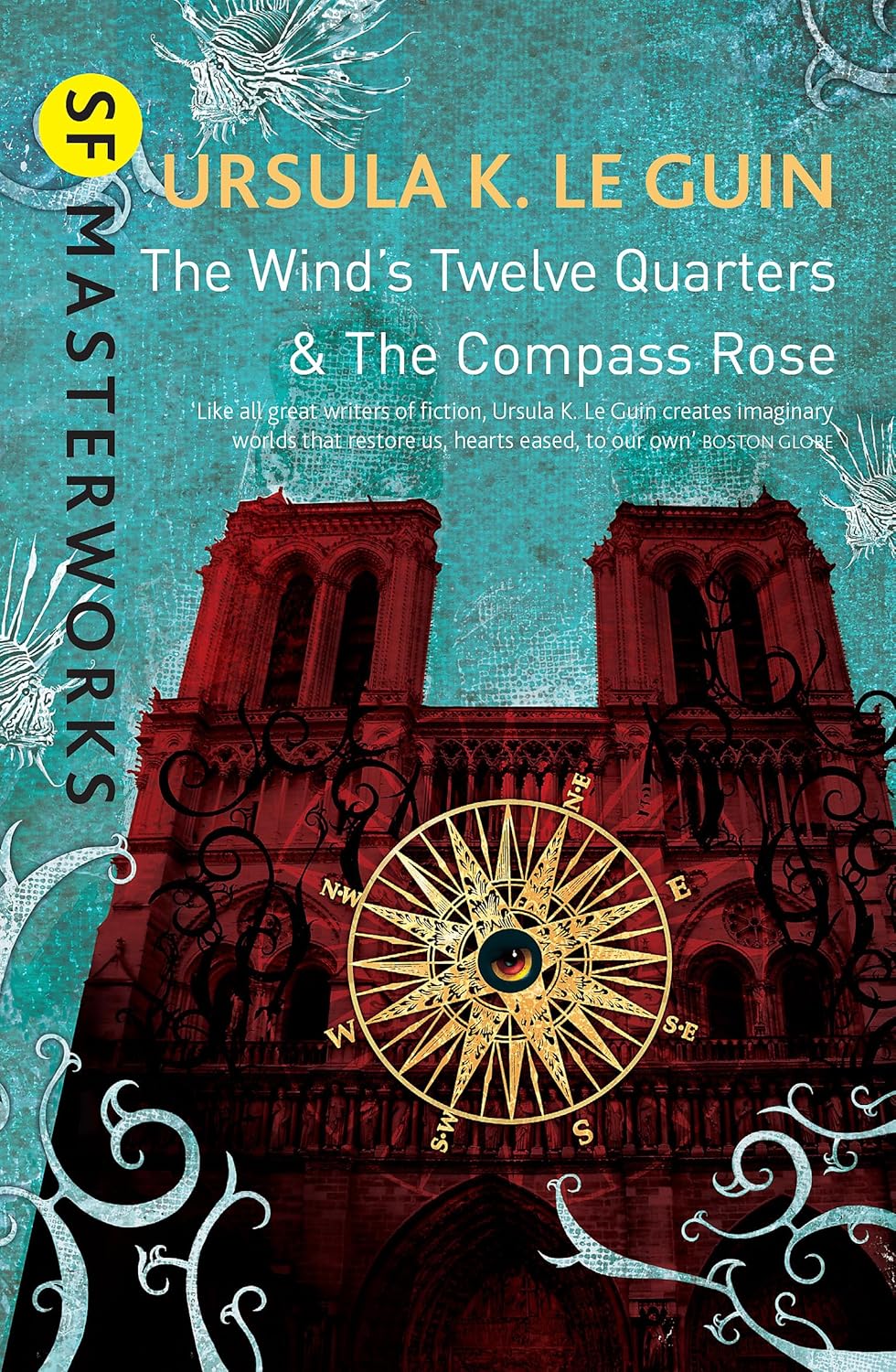
The first two are separate books, confusingly published now in the one physical volume you can see the cover of (to the right).
The Wind’s Twelve Quarters
The Wind’s Twelve Quarters starts with Le Guin’s first ever published story from 1962, and ends at the start of the 1970s. Because they are early, it has a solidity, an accessibility, and a cleverness used in a raw unpretentious way, which show her underlying skill and wisdom.
There’s hard yet emotional sci-fi pieces, set in the same world as her most famous two Hugo and Nebula award winning novels.
There are beautiful wizard battles, as compelling as something in a D&D film, yet poignant with an ethereal otherness to them.
There’s the claustrophobic tale of an astronomer whose observatory is despotically burnt down and who hides in a mine.
There’s the utterly moving life story of an old woman looking back on a successful anarchist revolution.
Pretty well every story caught me, held me, moved me.
The Compass Rose
The Compass Rose is full of delights, many of the stories still feel uniquely prescient even though they were written in the 1970s.
A new academic discipline, in which we learn to speak to animals, is echoed in the actually real AI driven Earth Species Project. It is also the final straw leading to the vegan campaigner’s utopia in the film Carnage. (A headset you can put on a goat, so the animals say what they are thinking in the voice of Joanna Lumley).
A machine that can show people’s imaginations and other thoughts going on in their mind, with a remarkably nuanced portrayal of what that means. The plot shreds things apart, as if my inner experience hero psychologist Hurlburt was flung into a totalitarian state.
A heartbreaking depiction of what it is like to lose the one thing that you are magically and powerfully good at (a rare harp, in the story), and how you should react to that and continue to live the rest of your mundane life. This is too close to home, my own craft taught to me by my father when I was a child in the early 1980s, vanished in but a few months, the cocaine speed barely, but tearfully, mourned.
Half the stories in this are weak or mixed, but they’re all amibitious and challenging and fun and unique.
Always Coming Home
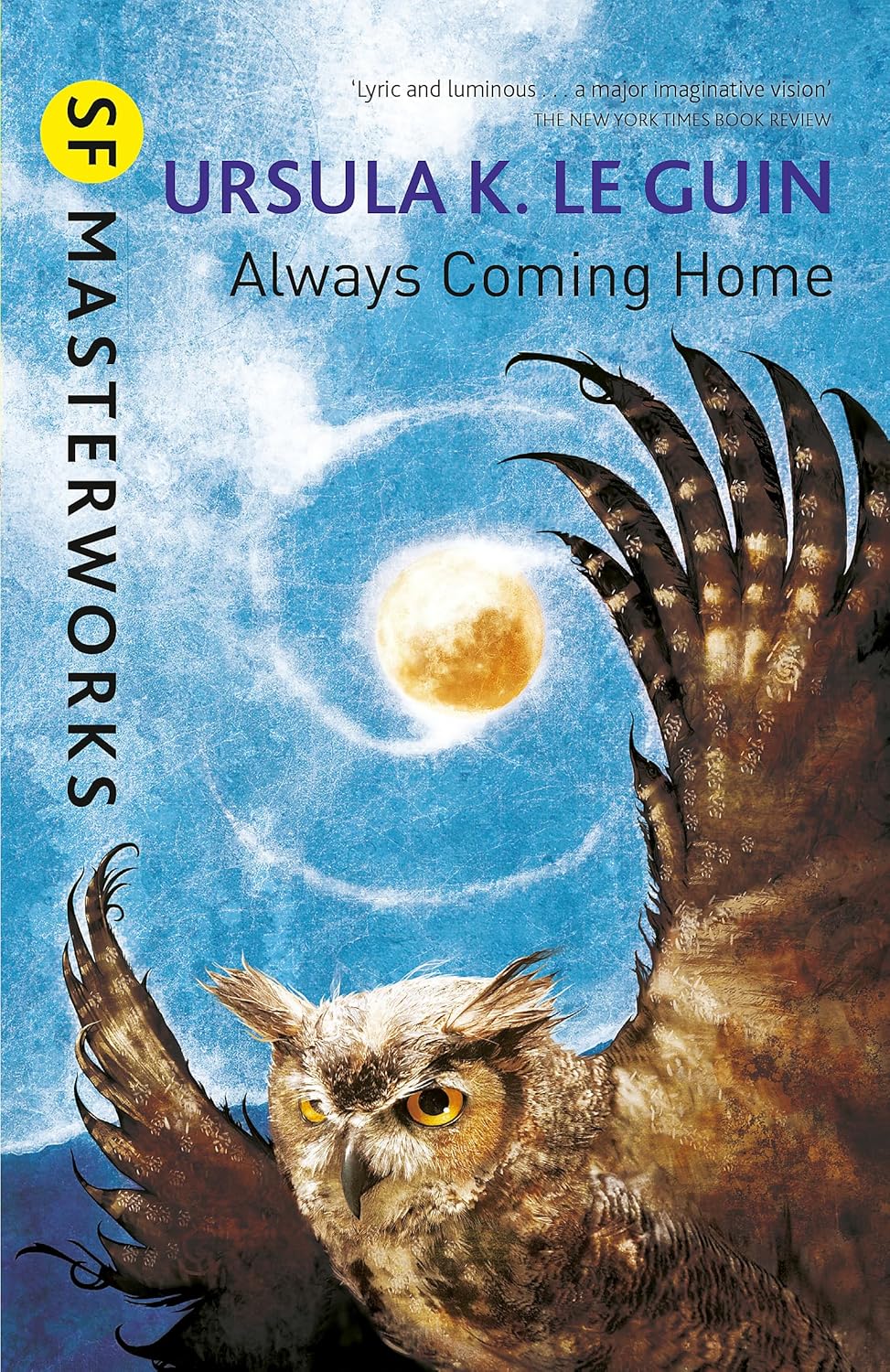
A couple of years ago, I was heading to Scotland to rewild and then camp alone. I only had a few minutes after work to grab a book for the holiday.
Donlon Books is my local, literary, curated — pretentious! — book shop. And I found Always Coming Home, a daunting fictional future anthropology of a unique way for humans to live. I was worried at the risk. Was taking this fat, dour book too much to handle alone in the wilderness?
While it has real stories in it, including a novella, it also just has lots of ethnographic artefacts — mythic texts, recipes, language glossaries, religious diagrams, histories.
My mind flits over them. It sucks me in, whisks me up, calms me, envelops me. I imagine the freshness and connection of the people. A sense of purpose and kindness and simplicity.
For months, years later, in arguments in the pub about the future of civilisation, how we can structure a more humane world order… The impossibility. My mind always wants to be in Always Coming Home in its emotions, even though it doesn’t know rationally how we could ever get there.
There’s nothing saccharine about this world, it’s by no means dreamy, it’s harsh and clear, more technological than it seems. The psychology, the mood, is rich and detailed, in a way you can only absorb slowly.
It’s a utopia in which seasons pass, winds blow. Boats give lifts across newly formed inland seas. A girl wanders as a coming of age ritual and gets lost on the wrong side of the wrong mountain. Children dance on rooftops as a festival reverberates throughout town.
The man in the coffee shop with the five year old child was a big Le Guin fan. I could tell, because he had read Always Coming Home.
Loading responses…