Say “Hello”

Finally bowing to modern two-way communication, I’ve enabled comments for this blog. To add your own thoughts to one of my posts, click on the little link which says “No comments” (or the number of comments that there are). And fill in the form. Please say “Hello” now to check it works!

If you get the email subscription to this, note that I’ve migrated it from Yahoo Groups to the new blogging software I’m using. Let me know if this email is or isn’t working, or doesn’t look right. I’ll post to the Yahoo Group soon, and then shut it down if everything is fine.

Bindery and Conservation

On Wednesday a couple of friends who work at the Cambridge University Library showed me round. The only bit I took notes on was the book conservation section and the bindery. The UL is a copyright library, so gets all books printed in the UK for free, and it also buys foreign books and pamphlets. In total over 120,000 new books arrive every year. Some of these are lent out, and many of those have to be rebound to be strong enough. As well as all these new books, they also have lots of very old ones.

Conservation

The conservation section is where ancient manuscripts are worked on to help preserve them. J showed me a book he was working on rebinding. It was originally bound in oak, a few millimetres thick, and covered in calfskin. Not only the cover was made of hide.

So slack are modern people with the term, I hadn’t realised before that parchment was animal skin. Before paper was made from trees, monastries would use the lamb hides from their large herds to make books. I felt the paper of one, it was softer, less course than tree paper.

When exhibiting an open book you have to be very careful how it is supported in its stand. J showed me prototype stands he was making to hold a book for public display. They were made from cardboard; when he gets the size and shape right they are made into plastic. The angle is careful chosen, and the points where the book makes contact with the stand. If it is on display for six months, the pages will droop downwards and permanently damage the book. You have to build little struts out to hold up the bottom of them.

The books were gorgeous handpainted medieval works. One was religous, the other scientific. Both still had vibrant colours centuries later, and lots of detail in gold leaf. One of them had been quite badly damaged by rebinding in the past, with the tops trimmed off pages removing bits of the text.

Bindery

Book re-binding is a violent but delicate passtime. Everyone in this section has a special way of handling books, that minimally harms them. They would gracefully raise the books up, lifting them fully off surfaces before sliding them along to their destination. There were two main rooms, accidentally gender segregated; the guillotines and glue were operated by men, the sewing done by women.

The first level of binding is a simple plastic sleave, or a slightly fancier glued-on paper covering. These are used if the sewing is already good on the book. If the stitches are no good, then they use violence in the form of a formidable guillotine.

Slice! Slice! The blade cuts along the entire length of the book in one stroke, removing a millimeter perfectly. The operator slices again and again until just enough of the spine is removed so all the pages come apart. For some journals, the pages from a sequence of issues are put together to form one volume.

According to the strength of paper, the pages go either to a mechanical sewing machine, or to a human. The machines are large, old and clever; intricate sytems of needles and microswitches which can bind a book together with thread. The binding girls sit in a cosier room, no doubt gossiping if I wasn’t there, looking at pin-ups of hunks, and painstakingly knitting a spine together again. Hand made stitches are much stronger. It gave me a surprised feeling of tradition to see work like this still done by hand.

Next the book goes through a complex sequence to apply the cover, which is called a case not a cover. Firstly this involves hammering the spine to get it in the right shape. Also now done with a machine. Then there are various layers of applying paper, cardboard and glue, and pressing the book. To finish off a computer operated machine stamps words in gold on the spine. Just 12 years ago they used to stamp the letters on by hand.

Despite all this mechanisation, the number of bookbinder staff has continued to rise. This is because the number of books arriving is going up and up. Information overload for some, but the library system is coping admirably. They are building yet another new extension.
Californian Cities

I’m back in San Francisco after a road trip all the way down to San Diego. I’m flying back to Europe later today, so it’s time to post some impressions of America.
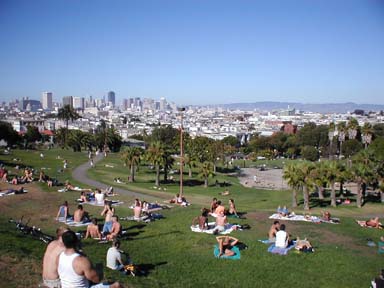
California is itself quite diverse, and no doubt the rest of the US is even more so. When I arrived here, I was surprised how roughly cut it felt. San Francisco feels most like a Latin American country, curiously the most similar feeling place I’ve been to before is Cuba. Of course, San Francisco is much richer, but it lacks glitz. The road surfaces are imperfectly maintained. There don’t seem to be any shops because their hoardings are so modest. No glaring neon adverts, or bright bold colours advertising their windows.

After going to Burning Man, San Francisco felt much more familiar and homely. It’s a fab city, with endless surprising views down the long crazy roads which shoot over hills. The photo above is of the corner of Mission Dolores park on a Saturday, when many tanned and body-built gays pose in the sun admiring the view.

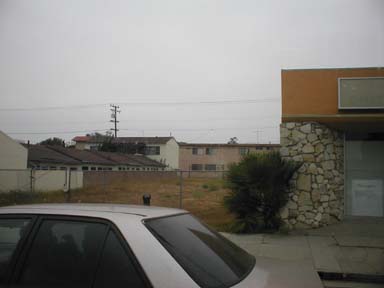
Los Angeles. Hell on earth. The movie industry is incredibly good at PR, at disguise. They manage to make the city look good! But really it is endless eternal, indistinguishable bleak city blocks. No people walking round, except clumps of latinos lurking (probably waiting for work buses to take them picking in agricultural fields out of town). Empty lots in areas which should be valuable (photo left). Repeated burger chains and cheap superstores. Only the rarest gems of quality, each 20 minutes drive from the last. Even the famous part of Hollywood, with stars on the walkways and the Oscars’ theatre, is a grotty boulevard, beaten by far by the theatre district of every other city that has one.
It’s like a normal city which has been insanely squashed and spread out. There are many parking lots because you have to drive everywhere. You have to drive everywhere because there are so many parking lots to drive past to get to your destination. Next time I find anyone promoting out of town superstores in the UK at the expense of, say, building new town centres, I’m going to kidnap them. Fly them to LA, pick a random street intersection and drop them there with a compass and no money. Make them walk to civilisation, so they can properly see the awful consequences of not planning a town with a civic centre, with structure, with design and art.

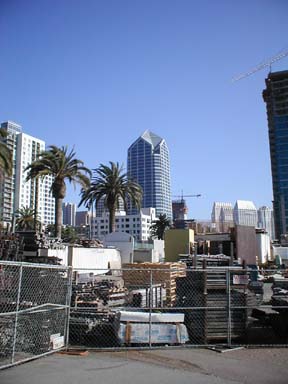
Somebody has been planning San Diego (the photo to the right is of downtown skyscrapers taken from across a building lot). Yes, gorgeous Balboa park was made by horticulturist Kate Session in the 1890s. Yes, the happening gaslamp quarter was deliberately redeveloped in the 1980s. They’re both lovely, they feel like places. Even our generic Super 8 motel had spectacular views in San Diego.

OK, maybe I was just happy because we found the Karl Strauss brewery at 10pm on a Saturday. Amazingly, then is happy hour at just $2 for a pint of microbrewed ale. No, it’s not just that. San Diego really is that dreamy Californian paradise on earth. And so much more tasteful than I thought.

Tombs

This afternoon I saw some amazing tombs, also from the Nguyen dynasty. One of them was also used as a hideaway by the king – not happy with the imperial palace, he has a second palace next to his tomb. The high taxes and forced labour to build it were so detested there was an attempted coup during the building.

The tomb itself is magnificently landscaped, with a huge slab describing the kings life in his own words (in the old Chinese-like characters the Vietnamese used to use). He even says bad things on it about his reign, apparently! How someone, along with his society, can accumulate the power to build things like this is extraordinary, fascinating, and I believe quite wrong.

A small reprise about language. French is actually quite useful in Vietnam, if only because of the large number of French tourists. A couple of people I’ve actually had to speak French with, which is very satisfying. My complex feelings about English being the global language get even more complex at this point… Bascially, I concur even more with the Esperanto theory that a world second language should be neutral, and not anyone’s native language. That way everyone has made the same effort to learn it, which makes people feel more equal, and puts both parties at more ease.

If you’ve tried emailing me recently, or tried looking at my website, it probably didn’t work. I’ve had trouble with the hosting account of flourish.org which is hopefully sorted out again now. Please try sending any emails again, and let me know if you have any problems still! ;) Special message for my Mum: You will need to reconfigure your email, because it is at flourish.org, and I can’t remember the password that you used to have. This isn’t scary, ring up Ray and he will tell you what to do.

Bus to Bangkok

Wow! I just had the most luxurious bus journey I could ever imagine. Sometimes people who like cars have a lack of imagination about how good public transport could potentially be these days. To inspire you, here are the highlights of todays trip:

  • The bus was due to leave Chang Rai in the far north of Thailand at 8am. It was ten minutes late leaving, the only flaw in the whole journey. It arrived at 7:30pm this evening (11.5 hrs later) in Bangkok. The journey is a distance of 785km, slightly shorter but roughly equivalent to travelling from Aberdeen to London.
  • I travelled VIP class, at a cost of 700 Baht, about 14 US dollars or 10 pounds. Admittedly everything is a bit cheaper in Thailand, but even allowing for that, this seems excellent value (National express charge 35 pounds for the economy class trip from Aberdeen to London, which curiously takes about the same amount of time).
  • The coach had only three seats across, two on one side of the aisle, one on the other. There were only 24 seats in the whole coach, half the number of economy class seats that could have been squeezed in. I had lots of space and leg room, and I’m very tall.
  • Not only was it air conditioned, but they gave you a blanket in case this made you cold. Or to huggle under to help you sleep.
  • Like an airplane, refreshments were servered at your seat. At the start, a bottle of chilled water. In the morning, coffee and some excellent pastries. In the late afternoon a can of cool coke, and a refreshing perfumed napkin thing. We stopped for lunch (included in the price), which was rice and a Thai curry. Yum.
  • There was a film in the afternoon. Admittedly it was a ludicrously silly Chinese movie for kids, about the God of Cooking who would use marshal arts maneuvers to slice vegetables, mix sauces and create excellent food, and compete with similarly talented rivals. Dubbed in Thai with no subtitles, so perhaps I just didn’t understand what was going on.
  • Most importantly, there was a toilet at the back of the coach. This is a great luxury, not featured in even the most upmarket executive cars. Thai roads are very straight and very good quality, so the bus hardly had to turn a short corner, which meant the toilet was usable.
  • You could walk round and read books and write and look at the scenary and sleep and think.

If private cars were to be banned, the free market would make all journeys this good within months. Of course, in the new high tech economy these vehicles would also feature:

  • Screens on adjustable arms that come out the seat in front, and feature: video on demand (streamed from a hard disk), music on demand (from a massive licensed library), computer games (multiplayer with other passengers), internet access (web and email). All with headphones, of course.
  • Sockets for recharging your mobile phone, or any other common electrical device (adapters available from the stewardess).
  • Wireless ethernet / wired ethernet / infrared for internet access from your laptop computer or PDA.
  • Full at-your-seat bar and snack service (i.e. you can pay for extra food/drinks/sweets/fresh fruit…).
  • Full through ticketing between all forms of public transport, including luggage, door to door. In other words, when the bus stops, a licensed taxi driver would automatically meet you, collect your luggage, and take you to your exact final destination, all included in one ticket price. Similar help would appear when you set off. There would be pre-paid porters at every major station to help people with luggage when changing between buses/trains/boats, or to provide other services at a supplement (please could you get me such-and-such a novel from the bookshop across the road…). Also you could send a trunk ahead, like in the Good Old Days.

Repeat after me… We will help save the world from the destructive weather patterns caused by global warming, whilst simultaneously improving service, building community, and creating jobs, by making truly excellent public transport.

Happy Tuesday. This afternoon I went into the Harambee centre again. Talked to Sheila there about the DFID research project, and I’m going to help her next week with sending out an email questionnaire. You’d be amazed at how hard it is deciding what format to send a questionnaire in. We decided against emailing Word documents in the end because it’s easier to just hit reply to a text email.

Also updated the virus checker, and had another go with incremental CD backup. The CD software didn’t work quite how I expected – it claims to have appended files to the CD, but they don’t appear. Needs more work. Finally, we registered a domain name! harambeecentre.org.uk

After having been half shaved my hair is definitely back up to furry length now. It was prickly to start with, but when the gap between the hairs becomes smaller than the length of the hairs, it suddenly feels like a cat.

Thanks to everyone who made a donation for Jimmy’s Nightshelter / The Big Issue Foundation. It was a fun experience, and much appreciated. Pete, I think my halfhead email signature got you one extra donation today from an old employee.

Recently I’ve been trying to help out the Harambee Centre with their computers. They’re a development education resource centre in Cambridge, which basically means they help teach children about international development. This ranges from being a library of lesson plans and resources, to organising events at schools.

Last Monday afternoon (when I should have been writing about Buddhist warehouses) we ordered a new computer from Crimson Technology, Wayne’s company. He’s delivering it on Thursday. It’s paid for by a grant from the City Council. It seems almost accepted that computers are disposable and you have to get a new one every three years.

My open source politics are being held subservient to pragmatics, so it’s going to run Windows XP. My friend Phil who does lots of IT work for charities in London is going to come up and help network the two computers together, so they can have proper file and internet connection sharing. Hooray!

Hello. I meant to begin last week, but got myself in a tangle deciding what a blog is and isn’t. Frimlin just told me to post anyway, so here I am.

Last week was my first week after finishing work at Creature Labs.

On Monday I went to visit Windhorse Trading, a warehousing business on the outskirst of Cambridge entirely staffed by Buddhists. It was an interesting place, I took notes and I’m going to write it up. I’m just not sure what form to write about it in. It might be a suitable K5 article, perhaps an entry in this blog, or a web page of my writeup. Journalism without a goal is hard.

I spent most of the rest of the week doing a contract for Ravenbrook in Cambridge, which was good. It’s nice being a free agent. It’s not so much that you can decide what you want to do, but you can decide how much you need paying to make you do something you otherwise wouldn’t do. In IT contracting, anyway, the relations with the employer are more equal. Bitwork in less lucrative industries, or for people with mortages/children is probably a bit more opressive.

On Friday I slept ;)