Blog

Communal pets

India is unusual in having two shared public “pets”.

Dogs are the ones that I’ve seen before in other countries, prowling every street and temple. These puppies with their sore-furred mum are in Pushkar.

Unusually, people feed them. The other day while waiting for a safari at a tiger reserve, I saw a woman feed a whole packet of sweet biscuits to a cute dog with lovely fur. Apparently the last chapati of a batch is reserved for a dog.
Continue reading →

Zero marginal cost

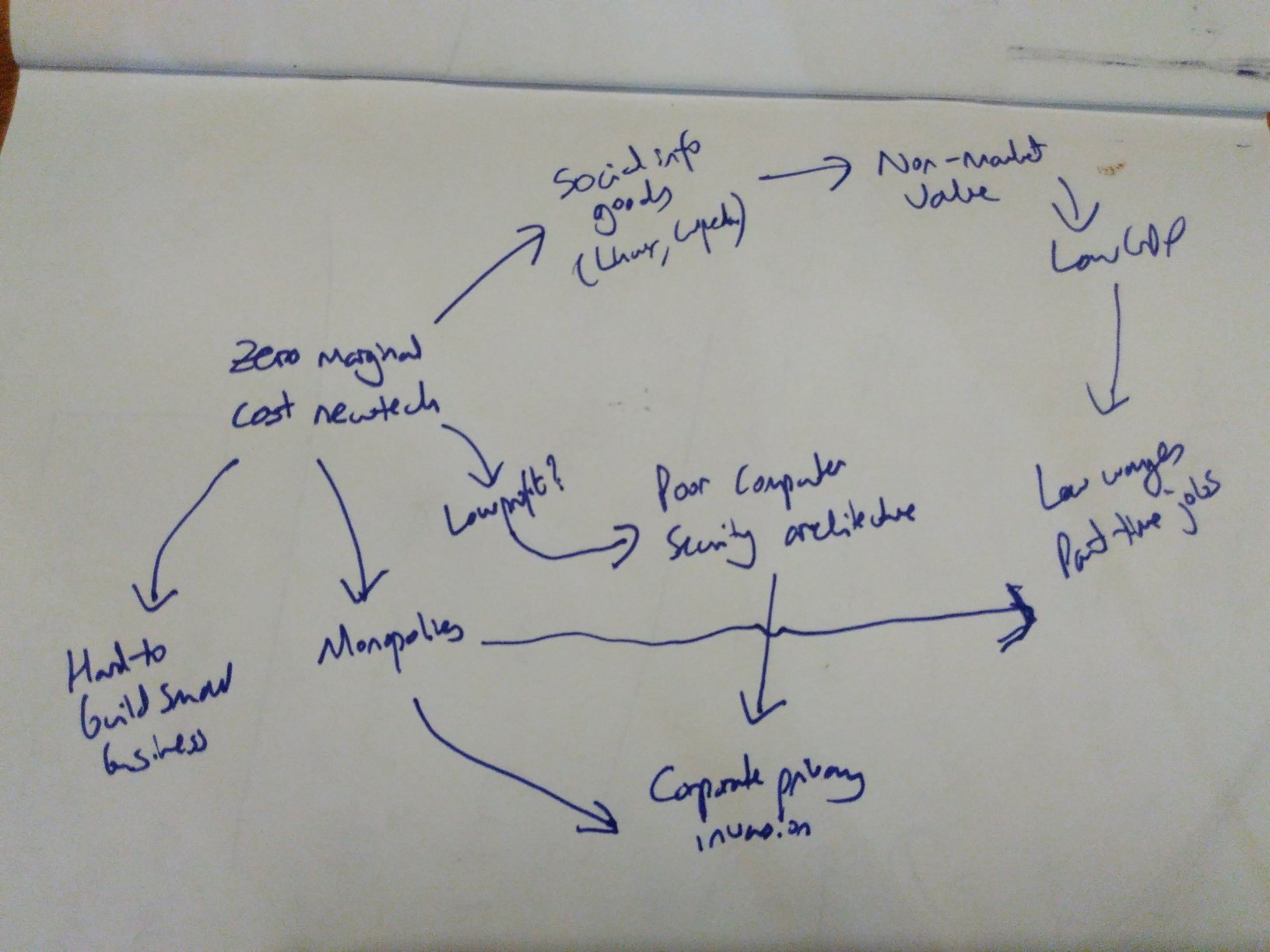
The next page I found in the notebook (after the last one) is my own view of the problem of information goods having zero marginal cost, so not functioning within capitalism. Paul Mason describes this in Postcapitalism.

Walking through the diagram…

“Zero marginal cost newtech” is the starting point. A “marginal cost” is a business term for the extra amount it costs to make one more of something. For digital goods, such as MP3s or converted PDFs, this is essentially nothing. This leads to the possibility of cheaper and cheaper, more and more freemium business models, driving the value of the information good in and of itself to nothing. The arrows lead out to four options at this point.

Continue reading →

Sea. Sunlight. Calm. Trees. Laughter.

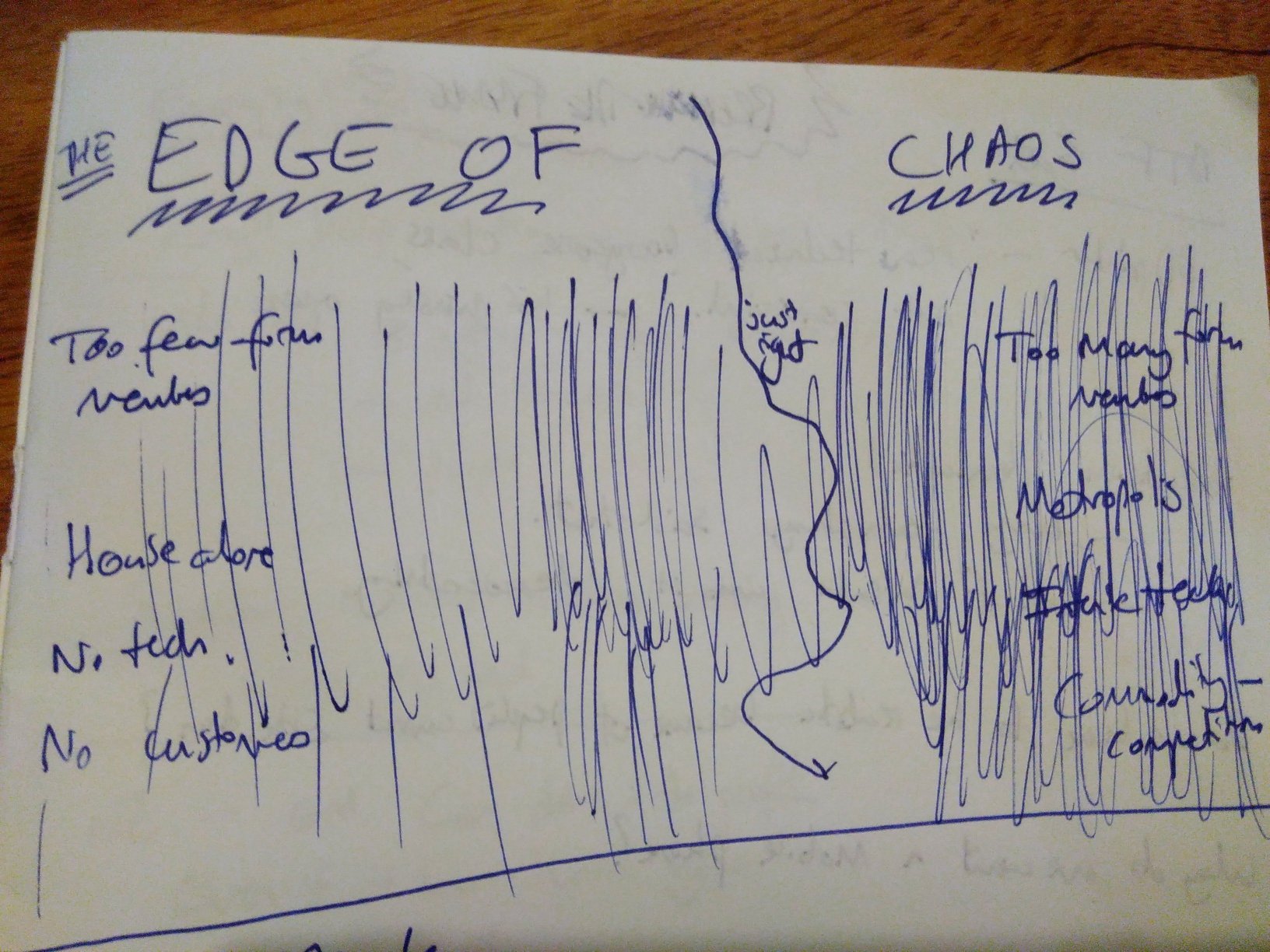
I found another oldish notebook. It’s about the edge of chaos.

The more lightly shaded left hand edge is absence, null, non existence. The dark shaded right hand side is total chaos, randomness. The sharp line down the middle is the edge of chaos - where things are balanced, interest lies, life grows.

There are four examples.

1. “Too few forum members” vs “Too many forum members”. If you start a new community, and nobody joins, it’s pointless emptiness. If it goes wild, and too many join, it ends up like a newspaper comments thread. There’s a pure balance, where the community is interesting and viable. (Reddit tries to avoid this dilemma by dividing itself in a cellular way making lots of subreddits)

Continue reading →

On finding political axes using maths

Drifting in the sea of political beliefs, left and right don’t seem to have any meaning any more.

It’s possible to make up new axes. Alas, these aren’t grounded in real views of the population, instead they’re distorted by the politics of their creators.

Luckily, there is a way of finding actual axes by experiment, using opinion polls and maths.

Back in 2005, my friends Chris and Tom persuaded a youthful YouGov to add a complete set of political position questions to their demographically weighted UK poll.

Continue reading →

History of libraries

Thanks to the excellent Thinking Liverpool [1], a lunchtime talk about the history of libraries caught my eye.

I mention the history of public libraries worryingly often. I make an analogy between libraries in the age of the printing pres and the modern need for equivalently novel public institutions in the age of the networked computer. Time to find out more.

It was in the Victoria Gallery, just across the road from work. Great!

Continue reading →

Don't play the game, mutate the board

I found some notes I’d written at the start of this notebook, a few months old.

Notebook cover

I used to campaign in Cambridge for more Fairtrade coffee and chocolate. That was a “closed” tactic, as opposed to an “open” tactic like open source software or open data.

It worked - even the best selling chocolate bar Dairy Milk is Fairtrade now. The tactic slightly shifted the board of global economics.

Continue reading →

Sync/Backup workshop at Redecentralize Conference

The fabulous Redecentralize Conference was organised by Ira and a bunch of other volunteers. Its subject - how do we make the net resilient, private and fun again?

It was an unconference, so I decided to do a session on a personal itch I’ve had for the last few years - file synchronisation and backup.

I don’t have a nice way to manage my files - documents, music, photos, email. Syncing them across devices and keeping them backed up seems strangely harder than it did in the 1990s. At least, if you don’t just go all in and trust Google or Dropbox with them.

Continue reading →

Making our information society safe and fair

The topic of how to make our information society safe and fair regularly comes up in conversations.

I think we need some quite big, radical things. They’ll need new public service Internet organisations to implement.

This is my high level view list.

1. Access to culture

“People have too much knowledge already: it was much easier to manage them twenty years ago; the more education people get the more difficult they are to manage.” (one MP’s response to the Public Libraries Act 1850)

Continue reading →

Those brief moments when winning seems possible

This mad dash bad mixen fun up down world.

Forces smash hither and fither, 7 billion of us strange qualia, doing, being human.

Web culture, open source culture… sucked out of academia, hacking, sharing, making, funning, building. Just late enough for usability to be just there just cheap enough.

Smashed with.

Political culture… burnt out, tired, so so so good best world has ever been, so so so broken, media corporate capitalist socialist thought tangle.

Continue reading →

"I find politics inaccessible": User testing voter advice apps

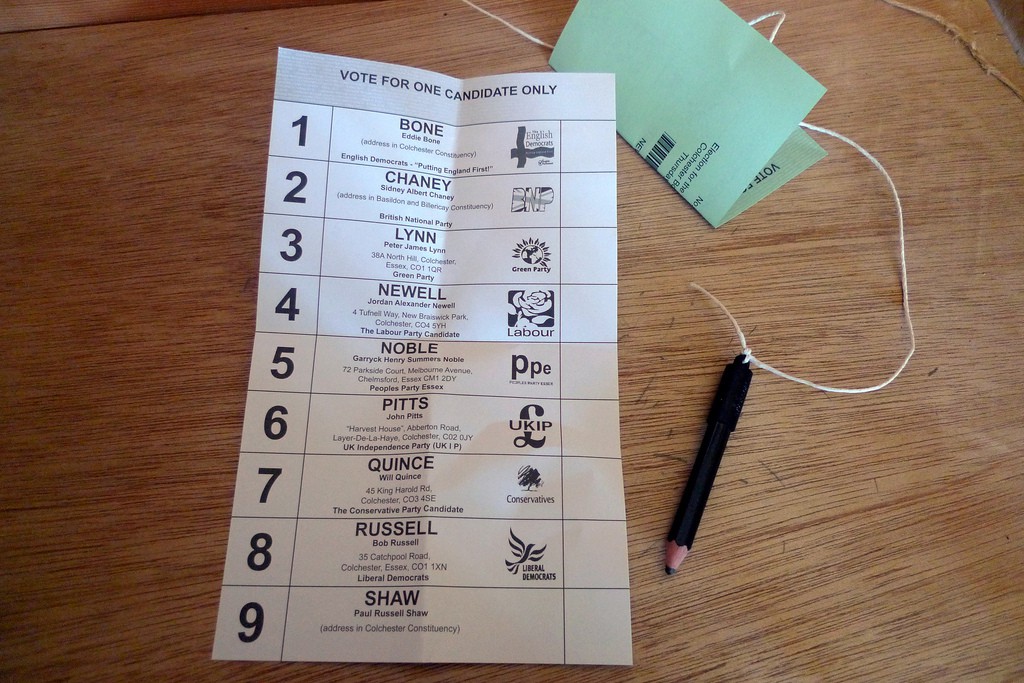
How is she going to vote? My friend (let’s call her F) just doesn’t know.

This isn’t unusual - about 20% of voters are like her (see Q3).

She needs to work it out fast. She doesn’t like polling stations, so has a postal vote. She has to decide this weekend - or she’ll get busy with work, and not remember to post the ballot in time.

4583274425_1919afba4c_b

mySociety helpfully list 16 voter advice apps, so I decided this was a chance to test them out!

Continue reading →