Blog

How to use time-travelling anthropologist pollsters to tell good from evil marketing

SplinterMany British geeks (including me, once) have an instinctive distaste for marketing.

This is wrong - it lets the evil people get all the advantages of marketing. It hides really good and useful products and services from people.

Instead we need a morality to distinguish the good from the bad. The only definition that I’ve come across - and it’s custom designed for geeks - is as follows (this is courtesy of Julian Todd):

Continue reading →

Awesome Foundation - Liverpool Chapter

There’s not enough awesomeness in the universe.

Don’t get me wrong, there’s quite a lot. But we could do with a bit more.

That’s why we’re lucky that Tim Hwang set up the Awesome Foundation a few years ago. It began in Boston, and has spread to dozens of cities.

How’s it work? 10 trustees pay $100 a month each to fund a $1000 prize. The prizes are awarded to things that 1) Have a purpose, 2) Are on a budget, 3) Create joy. Things like phones that can make calls without a base station, flooding a whole city with swings, or a stunning weather balloon to monitor the gulf oil spill. Things like that.

Continue reading →

Four ways we'll help WhipCar if they tell us what went wrong

Love they neighbour - drive their carIt’s as if your best friend had suddenly died and nobody would tell you how.

Heart attack? Car crash? Murder?

This time the afflicted isn’t a person, but a startup called WhipCar.

The idea of WhipCar… Rent your car out for the odd day or weekend to your neighbour to cover its vast cost. Or, if you don’t own a car, rent your neighbour’s car more cheaply and easily than a hire car.

Continue reading →

Mapping the product/market space - an hallucination

Imagine a vast multi-dimensional space.

Each point of it represents a specific need that a specific person has, an iota of utility.

The dimensions represent crazy things… Is the need in Africa or in Europe? Is the need on a LAN or on the web? Can travel to satisfaction of the need be done by public transport? How much does the need meet each of the basic needs? Is the need for shelter from the weather? Does satisfaction of the need require the skill of programming?

Continue reading →

Heroku's early history: 4 home pages that made $212 million

I decided to investigate Heroku’s early years.

You can learn a lot from even quite recent tech history (see my previous article on version control).

My tool? The Internet Archive. It’s an elephant that never forgets your pivots.

1. November 2007 - code in the cloud

Ruby on Rails is riding high. But impossibly hard to deploy.

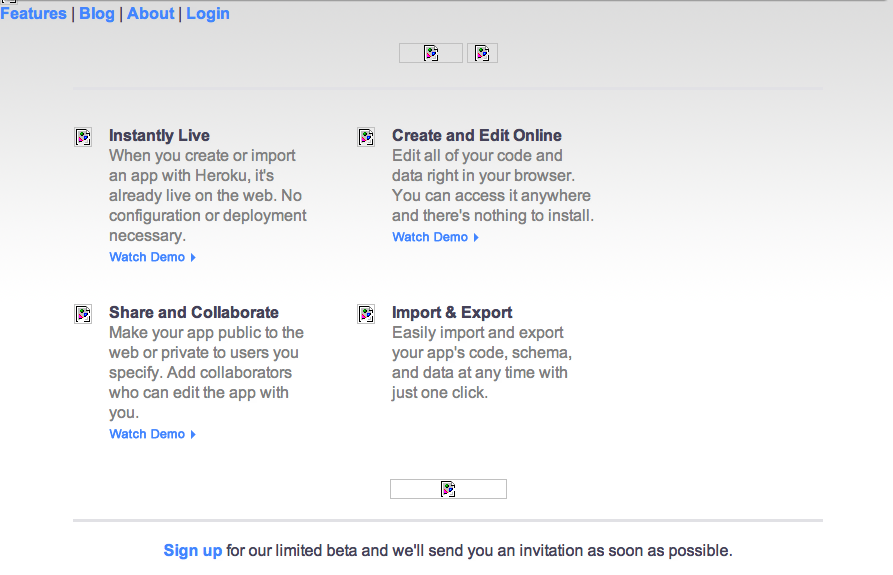
Y Combinator startup Heroku’s first home page (see right - apologies for the lack of images, which archive.org has not recorded) screams onto the web.

Continue reading →

Products and markets are the same thing

At [mySociety](http://www.mysociety.org/)'s annual retreat I gave a lightning talk about how I've come to realise that products and markets are the same thing. I'd originally intended it to be a blog post, so here you are.

It’s a story of geeks learning. What is a product? It really is magic.

Before the invention of products (whatever that means!) you had to make bespoke things. You want a tool, you have to bash the rocks together to make your own custom tool.

Continue reading →

Do epic shit! On being the first friend of DoESLiverpool

Today’s audio blog is about the excellent DoESLiverpool, and why you should be their friend too.

listen to “Do epic shit” on Audioboo

// < ![CDATA[ // < ![CDATA[ // < ![CDATA[ // < ![CDATA[ // < ![CDATA[ // < ![CDATA[ // < ![CDATA[ // < ![CDATA[ // < ![CDATA[ (function() { var po = document.createElement(“script”); po.type = “text/javascript”; po.async = true; po.src = “http://d15mj6e6qmt1na.cloudfront.net/assets/embed.js”; var s = document.getElementsByTagName(“script”)[0]; s.parentNode.insertBefore(po, s); })(); // ]]>

Continue reading →