Everywhere in the People’s Republic of China there is building. In Shanghai, deep foundations of new skyscrapers. In Songpan, new apartments paid for by the government to relocate people from slumy areas. And north of Songpan, a newly upgraded highway across into Gansu province. The only problem is, it isn’t finished yet.
The bus left at about 7am. The first part was easy, and after one last stop to pick up passengers in another small town, we entered the area where they’re rebuilding the road. Rebuilding it, that is, as we drive along it.
Kilometers of drying road surface, covered with a white material held down with rocks, while we drive along the other bumpy incomplete carriageway. Small, tortuous detours round unready bridges, the bus lurching over rough earth. Cement factories, with stores of different granularities of stone powder. Folorn clusters of individuals, miles from anywhere, slowly pounding and fixing verges in place with rocks, just clinging to the surface of the earth. Tractors carrying metal girders, gangs locking them down to hold the edge of the carriageway. Tent villages, signs telling new arrivals to report to the office first, nomad shops. Winding precarious tracks down round and up valleys, us looking up enviously to the skeleton of a dramatic new bridge that will take the new highway straight through. New tunnels boring into the fabric of our world.
The bus stopped for a while, the driver’s assistant refilling water in the radiator. I’m glad, because I needed a piss. We drive on for a bit longer. And then the bus stops again for an age. Everyone urinates again.
Two ages.
I chat to the other three foreign tourists on board, from Sweden, Switzerland and France. There’s a field of yaks. It’s cold, desolate weather. I get a second jumper out of my main luggage.
Three ages.
The shack we’re next to, built of brieze blocks, a corregated metal roof sloping in one direction, turns out to be a restaurant. Well, she has fresh vegetables to stir fry. The Frenchman, an entertaining rogue of whom more in a separate post, helps ourselves to tea from the hot stove. She doesn’t even charge me for my noodle soup, when I find a spider in it. The yaks get taken up the hill to graze elsewhere.
The Chinese bus passengers play a strange game, with long thin cards I’ve never seen. They play another with normal playing cards, and I spend a while trying to work out the rules. I get out the novel I’m reading, which I haven’t touched for weeks. The sun comes out, the place seems cheery. (Later I find my nose flaking, having not accounted for the extra power of the sun at high altitude). We start trying to hitch lifts onwards to Zoige from the meagre passing traffic.
Eventually a minivan with a mechanic or two and some tools arrives, and they start working on the engine. These buses have the engine at the front between the driver and the door, you get to it by lifting up the cover that normally has luggage and extra people on it. Several people get very oily hands, and more hours pass.
Only the worst buses get put on roads like this. The new ones are being saved for a year or two, when the tarmac is good, the surface sweet. This morning (a couple of days later) I took a bus from Langmusi to Hezuo, along a beautiful finished new road. It was a lovely shining white bus, the TV flat screen, the windows large and clean. I almost wept each time we passed over the smallest of bridges without detour. The new highway even has roadsigns at junctions, and giving distances to places. In Chinese characters, and also, a pleasant surprise, in Tibetan. (And not always in the Roman alphabet).
Back by the spider restaurant shack, none of the other passengers really seem to mind or complain about the delay. A few have managed to catch lifts on to their destination, so by the time the bus starts again there’s a bit more room in it. We’re broken down maybe 4 or 5 hours, and arrive at our destination of Zoige at 7pm. Far too late for the afternoon bus onwards to our actual destination Langmusi, or even to take a taxi between us.
All this turned out to be a bonus in the end, as an unexepected stay in Zoige is much more interesting than the guidebooks imply. The roads approaching it are straight, along endless grasslands at 3000m above sea level. Grassy hills protrude out of the planes, and people herd black yaks. There’s a fascinating village we quickly pass through, of unusual wooden houses with moss rooves, each with a Tibetan prayer flag in the garden.
Zoige itself is indeed a grid of concrete buildings, but lovely ones painted delicately with Tibetan art. The people seem friendlier, I buy water and snacks in a small family shop, and the man gets his young girl to give me the change. Some adults are playing outside. School finishes, strangely at 8pm (maybe something to do with International Children’s Day) and hundreds of friendly kids burst out, practicing their excellent English on me. (Later I learn that their teacher is Tibetan, educated in exile in India, so has good English.) Small children guide me to an internet bar, but it’s full. I eat home style tofu, attended carefully and courteously by the owner of a new Chinese restaurant.
When the new road opens it will bring new trade, new tourists, new immigrant Han Chinese. To Zoige and to Langmusi. Everything changes.
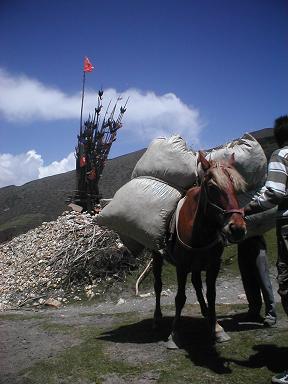 At the moment I’m in Tibet.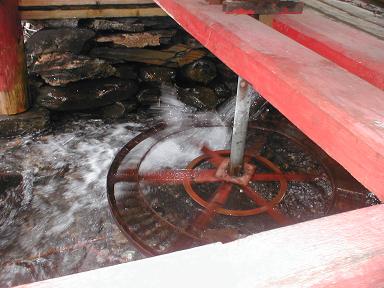
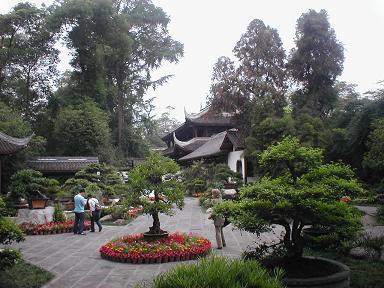 If you fall off the eastern edge of the Himalayan mountains, the first major city (population 4.1 million) that you come to is Chengdu, in China’s Sichuan province. You’ve heard of it from the spicy Chinese food, called “Szechuan” in the west.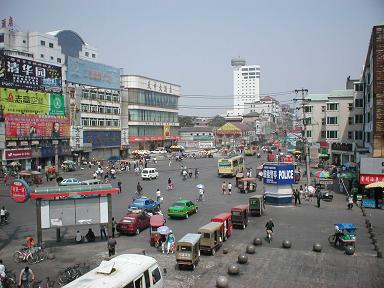
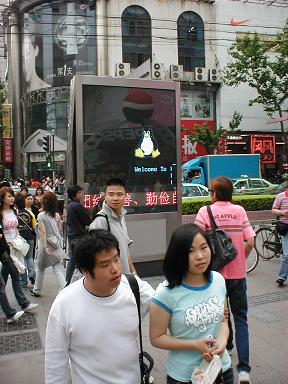
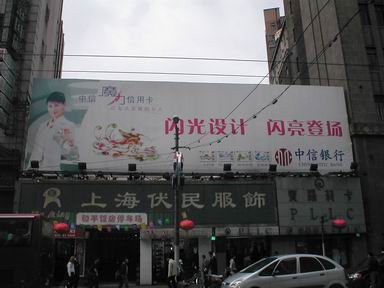
 I am impressed by the graphical style, for example in adverts. Perhaps partly because I don’t understand them! The picture above is of a typical example. Chinese writing has some beautiful fonts, and they have lots of stark white backgrounds, with colourful, uplifting images.
 Imagine it’s May 1945, the war in Europe has ended, and the Americans have captured (parts of?) Okinawa, the tropical island in the very south of Japan. Allied air raids are starting over Shanghai.
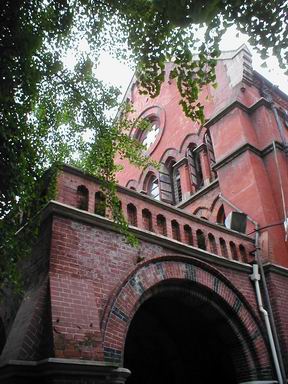
  We walked back, following the route of the family’s forced march 61 years before. It’s now a run down corner of Shanghai with tiny cramped shop/house hybrids and street food. We walked past the waterworks, which is a fantastic set of old crenelated buildings, well maintained, re-pointed and landscaped with flowers. You can’t get in, it is very much still in active use.
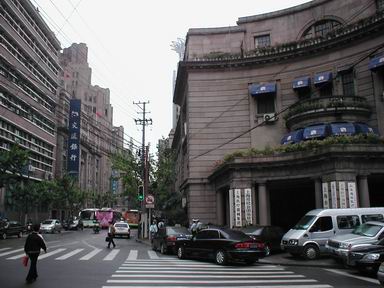
 Almost as soon as we got off the plane on Wednesday, Rosemary (my mum) dragged me from the tourist trap of the Bund, into some overcrowded, grimy backstreets hunting for the derelict cathedral where her parents were married and she was christened. The magnetic levitation train from Pudong Airport was great fun – not because it travelled at 431 km/h, the fastest train in the world, but because at some points the earth around us seemed to rotate at what felt like, but could not have been, an unnerving 45 degrees. It turned out that we were tilting, but so exactly as we cornered that you couldn’t feel any force.
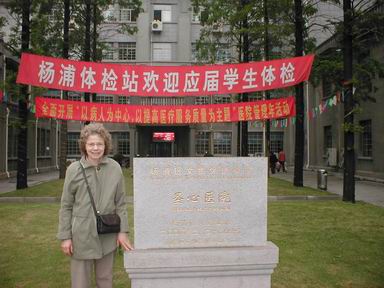
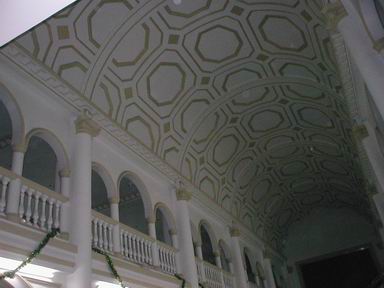
 We also found the old council building (photo left), and nosed inside. It’s lucky that the guards are friendly now, as it seems Rosemary won’t let any fear stop her from access to family history. It was grand inside, and there were lots of old framed photos of the building under construction, and of speeches from the balcony (see photo) to celebrate when the Communists took over rule of the city in 1949. My grandfather worked in here. He did lots of different things, mainly to do with water pollution, but also, for example, helping to develop tarmac suitable for the local weather.